
Kensington's paid fast-track planning route is live again: validation in a day, decisions in 10 working days, fees £530 to £1,395.20 on top of the planning fee.
Kensington and Chelsea Council is bringing back its paid fast-track route for planning applications. The service has been suspended since the cyber-attack on the council in November 2025.
Updated 22 October: the service is now open. The council’s Fast Track page, updated on 19 October, no longer says it is suspended and lists the new fees. The details are under “How it works now” below.
Cllr Johnny Thalassites, the Lead Member for Resident Services, Planning and Enforcement, signed the decision on 7 October. It approves a relaunch this month, a wider range of applications, and a new fee for each type of application instead of one flat charge (decision record, KD1014736). The council’s register says the decision takes effect from 16 October.
On Saturday 10 October the council’s own Fast Track Application Service page still said the service was suspended and would return “in Autumn 2026 with updated fees and procedures”. It still showed the old flat fee.
How it works now
The council’s page sets out these timescales:
| Step | Fast Track | Standard service |
|---|---|---|
| Validation | Within 1 working day of payment | No set timescale |
| Decision, no consultation needed | Within 10 working days of validation | Up to 8 weeks |
| Decision, consultation needed | Within 2 working days of consultation ending | Up to 8 weeks |
| Contact from your planning officer | Within 5 working days of validation | No set timescale |
Consultation usually ends within 28 days of validation, the page says.
To use it, you submit the application in the usual way, such as through the Planning Portal, then request Fast Track by email using the council’s template. The request must come from whoever submitted the application, usually the agent. The council says it will confirm within 1 working day whether it accepts, and you then have 2 working days to pay. It does not accept every request.
What it costs now
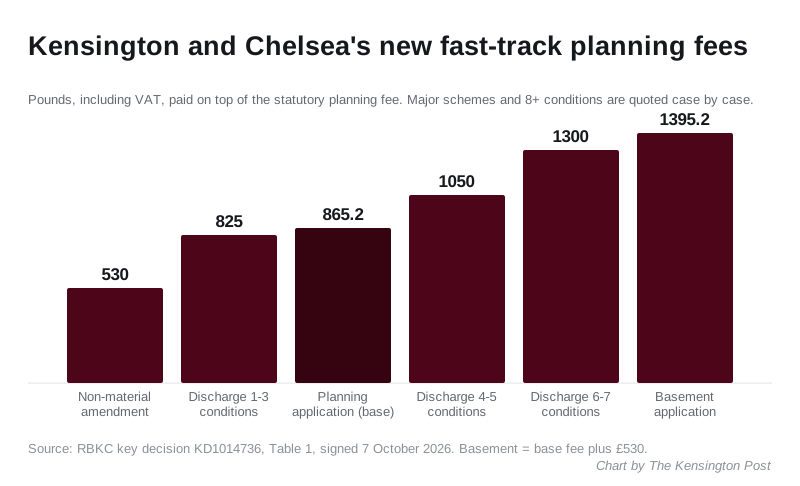
The fast-track fee is paid on top of the normal statutory planning fee. All the figures include VAT. The new schedule is in Table 1 of the officers’ report:
| Application | Fast-track fee |
|---|---|
| Planning applications, including section 73, advertisement consent, listed building consent and certificates of lawfulness | £865.20 |
| Basement applications | £865.20 plus £530 |
| Non-material amendments (section 96a) | £530 |
| Discharge of 1 to 3 conditions | £825 |
| Discharge of 4 to 5 conditions | £1,050 |
| Discharge of 6 to 7 conditions | £1,300 |
| Major applications, or 8 or more conditions | Quoted case by case |
So a basement application on the fast track costs £1,395.20 on top of the planning fee. The basement add-on matches the price gap the council already uses in its pre-application advice service, according to the fee calculations appendix.
The main fee stays at £865.20. That is the £800 launch price of January 2024 after the council’s annual uplift. No further rise is planned this year, but the fees go up each April in line with the national planning fee increase.
What you get for the money
Paying does not buy a different answer. The report says the route “affects processing speed only” and fast-tracked schemes face the same policy and consultation tests as any other.
The council commits to:
- validating the application within one working day of receiving the fee
- deciding within two working days of the end of consultation, where neighbours or consultees have to be asked
- deciding within ten working days of validation, where little or no consultation is needed
For a householder application that usually means a decision in about 28 days. Certificates of lawfulness and most non-material amendments fall into the ten-day group. Major schemes get their own timetable with the quote.
Not every request is accepted. Officers turn applications down where they doubt the deadline can be met, or where a site has a contentious history, an open enforcement case or significant public interest.
How the service has performed
The report gives the first full figures since launch:
- 2024: 200 applications, 179 decided and 21 withdrawn. 52% of decisions met the fast-track promise.
- 2025: 323 applications, 283 decided and 38 withdrawn. 44.6% met the promise, which officers put down to 44 cases stuck when the cyber-attack hit. Without those, the figure was 51.2%.
- 2026 so far: five applications handled as pilot cases.
So roughly half of paying applicants got their decision inside the promised time. Officers say the usual cause of a miss is a request for more information, amended plans or a fresh round of consultation.
The comparison with the standard route is starker. Over 2024 and 2025, fast-track decisions came a median of two to three working days after consultation closed, against 18 working days on the normal route. Fast-track cases were decided inside the statutory deadline 89 to 90% of the time, against 46 to 59% for everyone else.
Officers know of two refunds and six fee waivers across those two years. The refunds followed errors with site notices.
What it means for you
If you are planning works, you now have a priced choice. The standard route is unchanged and costs nothing extra. Watch the council’s fast-track page above for the relaunch date and the new fees going live. Our Kensington planning news covers what is being decided near you.
If you are a neighbour, the paid route does not cut your say. Consultation periods are the same length; only the wait after they close is shorter.
The council says the fee income pays for dedicated fast-track staff, so the standard queue is not starved. It also says the service can be paused again “at any time” if the statutory service comes under pressure. The report admits one risk to demand: national planning fees are due to rise in late 2026, which narrows the gap between the two routes. The fees will be reviewed after the first year.
The report notes that some may see a paid route as favouring those who can afford it. The council’s equality assessment found a neutral impact, because the standard route stays open and decisions follow the same rules.
Have your say